
The laboratory essentials, healthcare equipment, and air filtration manufacturing industries are highly technical and research driven. Buyers are not casual consumers. They are scientists, procurement managers, hospitals, pharmaceutical companies, research labs, universities, and biotech firms. These professionals rarely buy products without deep research.
Earlier, most of this research started and ended on Google search. But today the search ecosystem has evolved. Buyers now search through Google, AI assistants, voice search, research platforms, and conversational AI tools.
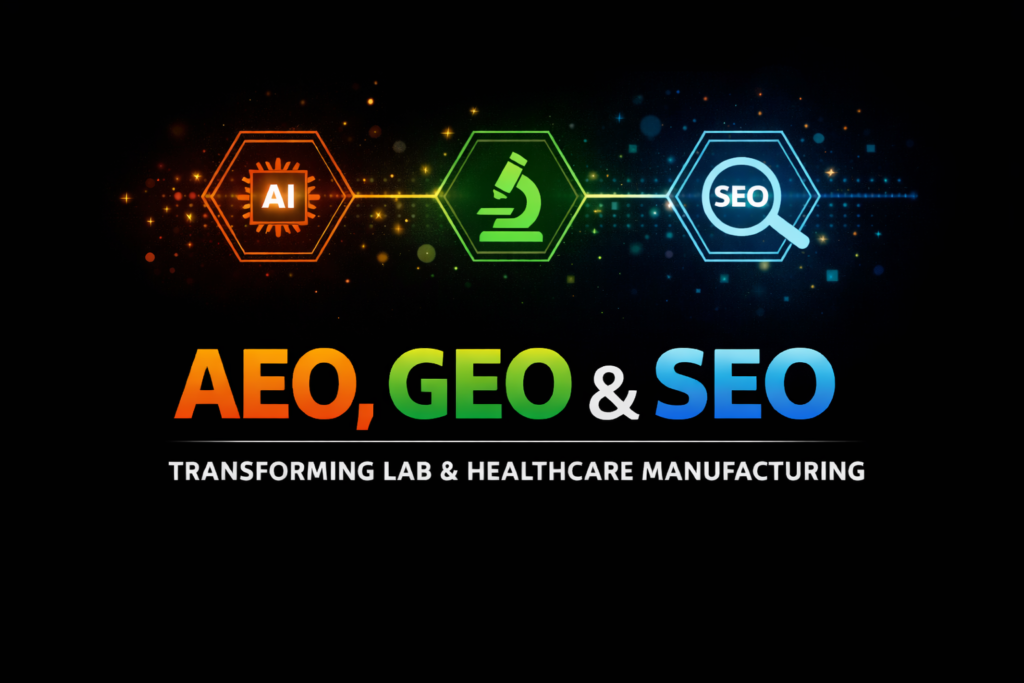
Because of this shift, three major digital visibility strategies are shaping the future of manufacturing companies in this sector:
• SEO (Search Engine Optimization)
• AEO (Answer Engine Optimization)
• GEO (Generative Engine Optimization)
For companies manufacturing lab consumables, healthcare essentials, and filtration systems, mastering these three strategies is becoming critical for global visibility, international distribution, and long term market authority.
The Digital Shift in Industrial Buying Behavior
Industrial purchasing has changed dramatically in the last decade. Earlier, distributors, exhibitions, and catalogs dominated the procurement process. Today the first step is always digital research.
A laboratory manager searching for products like PCR tubes, cell culture media, biosafety cabinets, HEPA filters, or laboratory instruments will start with online research.
However, the way this research happens has changed.
Instead of simply typing a keyword like:
“laboratory air filters manufacturer”
buyers now ask complex questions such as:
• Best HEPA filter manufacturers for clean rooms
• Which company produces laboratory filtration systems
• Reliable supplier for cell culture consumables
• Top manufacturers of biosafety lab equipment
Modern search engines and AI systems respond with direct answers rather than just a list of websites. This is where AEO and GEO come into play.
Search engines are now moving toward providing direct answers and AI generated summaries rather than traditional links.
For manufacturing companies, this means visibility is no longer limited to ranking on page one of Google.
You must also appear inside AI answers.
Understanding SEO, AEO, and GEO
1. SEO (Search Engine Optimization)
SEO is the foundation of digital visibility. It focuses on optimizing websites so they rank higher in traditional search results on platforms like Google and Bing.
For laboratory equipment manufacturers, SEO typically involves:
• Optimizing product pages for industrial keywords
• Technical website optimization
• Creating educational industry blogs
• Building backlinks from research websites and journals
• Improving website speed and technical structure
When a manufacturer ranks on Google for searches such as:
• laboratory consumables manufacturer
• air filtration systems for laboratories
• cell culture products supplier
• clean room filter manufacturers
they receive high intent B2B traffic from global buyers.
However, SEO alone is no longer enough.
Search behavior is shifting toward question based queries and AI conversations.
2. AEO (Answer Engine Optimization)
Answer Engine Optimization focuses on structuring content so that search engines and AI systems can directly extract answers from it.
Platforms like:
• Google AI Overviews
• Voice assistants
• Chat based search systems
• Knowledge panels and featured snippets
all rely on structured, answer friendly content.
Instead of only ranking a page, AEO helps a brand appear as the direct answer to a user’s question.
For example, when someone asks:
“Which companies manufacture laboratory air filters?”
the answer engine may directly display a summarized response citing trusted sources.
AEO increases the chances that a manufacturer becomes that cited source.
AEO is especially powerful in the lab equipment industry because buyers ask detailed technical questions before selecting suppliers.
Examples include:
• What is a HEPA filter used for in laboratories
• Which filters are used in clean rooms
• Best consumables for cell culture experiments
• How laboratory filtration systems work
When companies create well structured educational content around such queries, answer engines prefer those sources.
3. GEO (Generative Engine Optimization)
Generative Engine Optimization is the newest evolution in search visibility.
GEO focuses on making content discoverable and trustworthy for AI powered search engines such as ChatGPT, Gemini, and Perplexity.
Unlike traditional search engines that display links, generative AI systems produce synthesized answers.
These systems gather information from multiple sources and generate a combined explanation.
The brands whose content is well structured, authoritative, and technically accurate are more likely to be referenced in these AI generated answers.
GEO therefore focuses on:
• authority signals
• semantic content structure
• industry expertise
• entity recognition
• technical documentation
GEO ensures that when AI systems explain laboratory technologies or healthcare equipment, your brand becomes part of the knowledge base.
Why AEO, GEO, and SEO Matter for Lab and Healthcare Manufacturers
Manufacturers in industries such as:
• laboratory consumables
• biotech research supplies
• air filtration systems
• medical equipment
• healthcare laboratory essentials
operate in highly specialized markets.
Buyers are often international and technical.
Traditional marketing methods are limited in reach. But digital visibility can position a manufacturer as a global authority.
Here is how these strategies directly impact the industry.
1. Global Visibility Without Distribution Offices
Many manufacturers produce world class laboratory products but struggle to reach international buyers.
With strong SEO and AI visibility, a company can appear in searches from:
• USA research labs
• European universities
• pharmaceutical companies
• biotech startups
• government research institutes
Instead of relying only on distributors, companies generate direct global inquiries.
2. Building Scientific Authority
In scientific industries, authority matters more than advertising.
A manufacturer that publishes high quality educational content about:
• laboratory filtration technologies
• clean room standards
• cell culture methodologies
• biosafety practices
automatically becomes a trusted industry source.
AEO and GEO amplify this authority because AI systems prioritize credible and well structured information.
3. Capturing High Intent Buyers
Unlike consumer searches, industrial searches indicate strong purchase intent.
When a procurement manager searches for:
“laboratory air filter manufacturer for pharma plant”
that query often leads directly to vendor evaluation.
Ranking for such keywords through SEO and appearing in AI answers through AEO and GEO places a manufacturer directly in front of decision makers.
4. Dominating Niche Industrial Keywords
The laboratory equipment industry contains thousands of niche search terms such as:
• PCR consumables manufacturer
• laboratory HEPA filtration system
• biosafety cabinet filters
• cell culture lab products supplier
Most companies do not optimize for these keywords.
A strategic SEO, AEO, and GEO approach allows manufacturers to dominate these niche queries and capture the majority of digital demand.
The Future of Search in Industrial Manufacturing
Search is no longer just about ranking websites.
The future of digital discovery includes:
• conversational AI search
• voice based queries
• AI generated research summaries
• knowledge graph results
• zero click search experiences
SEO still builds the foundation of discoverability, but AEO and GEO expand that visibility into AI driven ecosystems.
Companies that adapt early will control the digital narrative of their industry.
Those that ignore these changes risk becoming invisible even if they manufacture excellent products.
Finally
The laboratory essentials, healthcare equipment, and air filtration manufacturing sectors are entering a new digital era.
Traditional SEO continues to drive organic traffic and keyword rankings.
AEO ensures companies become the direct answers to technical industry questions.
GEO positions manufacturers as authoritative sources within AI generated responses and research summaries.
Together, these three strategies create a powerful digital presence across search engines, AI assistants, and research platforms.
For manufacturers in specialized scientific industries, the companies that invest early in SEO, AEO, and GEO will lead the digital visibility race, attract global buyers, and establish themselves as industry authorities in the years ahead.
Frequently Asked Questions
1. What is SEO for laboratory equipment manufacturers?
SEO for laboratory equipment manufacturers is the process of optimizing a company’s website so it appears on Google when researchers, hospitals, pharmaceutical companies, or laboratories search for products like lab consumables, filtration systems, or medical equipment. It involves keyword optimization, technical website improvements, and industry specific content creation.
2. Why is SEO important for lab consumables and healthcare equipment manufacturers?
Most procurement managers and research professionals begin their supplier search online. If a manufacturer does not appear in search results, potential buyers may never discover them. SEO helps manufacturers increase visibility, generate international inquiries, and build credibility within the scientific and healthcare industries.
3. What is AEO and how does it help manufacturing companies?
AEO stands for Answer Engine Optimization. It focuses on optimizing content so search engines and AI platforms can provide direct answers to user questions. For manufacturing companies, AEO helps their content appear in featured snippets, AI summaries, and voice search results when buyers ask technical questions about products.
4. What is GEO in digital marketing?
GEO stands for Generative Engine Optimization. It is the process of optimizing websites and content so AI powered search platforms like ChatGPT, Gemini, and other generative search tools can reference and include the brand in AI generated responses related to industry topics.
5. How does SEO help air filter manufacturers generate leads?
SEO helps air filter manufacturers rank for industry specific searches such as clean room filtration systems, HEPA filter manufacturers, or laboratory air filtration suppliers. When buyers search for these terms, companies with strong SEO strategies receive qualified traffic and potential sales inquiries.
6. What type of keywords should laboratory manufacturing companies target?
Laboratory manufacturing companies should target industry specific keywords such as laboratory consumables manufacturer, biosafety cabinet filters supplier, cell culture products manufacturer, laboratory filtration systems, and clean room equipment manufacturers. These keywords attract highly targeted B2B traffic.
7. Can SEO help manufacturers get international clients?
Yes. A strong SEO strategy allows manufacturers to rank globally for industry related keywords. This helps attract distributors, research institutions, pharmaceutical companies, and laboratories from different countries that are searching for reliable manufacturers.
8. What is the difference between SEO, AEO, and GEO?
SEO focuses on ranking websites on search engines like Google. AEO focuses on appearing as direct answers in search results and voice search. GEO focuses on ensuring that AI systems and generative search engines reference and recommend a company when generating answers related to an industry.
9. How long does SEO take for manufacturing companies to show results?
SEO usually takes between three to six months to show noticeable improvements depending on competition, keyword difficulty, and website authority. In highly specialized industries like laboratory equipment manufacturing, consistent content and technical optimization can produce strong long term results.
10. How can manufacturers choose the right SEO agency for their industry?
Manufacturers should look for an SEO agency that understands technical B2B industries, has experience working with manufacturing companies, and can create industry specific content strategies. The agency should also have expertise in modern search optimization including SEO, AEO, and GEO.